
When we hear the name "Indian nut", we automatically think of something exotic, ancestral, with that air of mystery that surrounds everything that comes from the Indian subcontinent. We think of Ayurveda, of millenary rituals, of sacred spices... But here comes the important nuanceThe term "cashew nut" has been used for two completely different productsand this ambiguity has given rise to a great deal of confusion.
What "cashew nut" are we talking about?
On the one hand, we have the tree seed Aleurites moluccanusalso called candela nut , candlenutwhich is marketed as a weight loss supplement. This is the one that has caused quite a bit of controversy because of its toxic effects and health risksI'll tell you the details below (so you don't make mistakes when choosing the "cashew nut").
On the other hand, there is the cashew (Anacardium occidentale), a nut widely consumed throughout the world, which in some Latin American countries is also called "cashew nut".
This duality in the use of the name has led many people to associate both products with India -either because of their name, their appearance or marketing strategies-, when in fact they are not. only one of them has a real connection to Indian culture, y the other has no connection with the country.
How did this confusion with the "cashew nut" begin?
For years, the seed of Aleurites moluccanus has been marketed as a supposedly miraculous "natural product" for weight loss. In stores and websites, the so-called "Indian nut" appears wrapped in promises such as "burns fat", "purifies the body" or "reduces measurements while you sleep", appealing to that imaginary oriental wisdom. Many consumers, guided by the name, believed they were buying something of Indian origin, perhaps even Ayurvedic.
However, the reality is different: this seed is not IndianIt is not part of their cuisine, nor is it part of their traditional medicine. It is believed that on one of his return voyages to Europe, Christopher Columbus brought this seed from America, and upon arriving to the Old Continent was baptized as "nut of the Indies" -referring to the West Indies, as the New World was known at that time-, and no to the country India. The name evolved, survived the test of time and continues to cause misunderstandings today.
Is the non-Indian "cashew nut" dangerous?
Yes, very much so. The seed of Aleurites moluccanus -that which commonly sold as "cashew nut" for weight loss- has caused severe side effects: extreme diarrhea, dehydration, vomiting, abdominal pain and dangerous metabolic imbalances. In some countries it has even been banned for sale as a supplement. None of this has anything to do with a conscious and responsible approach to wellness.
And most importantly for me, as an India specialist: this seed has no relation with the Indian tradition. It is not part of Ayurveda, it is not part of any ritual, nor is it found in the cuisines of authentic India. Its use within any context that alludes to India is a misappropriation and misinformation.
Are cashew nuts related to India?
Yes, the cashew nut (kaju)although originally from Brazil, has a huge presence in Indian cuisine and forms part of many dishes, sweets, sauces and festivals. It is grown in abundance in states such as Goa, Kerala and Andhra Pradesh. And although in some places it has also been called "India nut", in this case there is an authentic link with the country's culture and tradition..
Other dried fruits and nuts from India
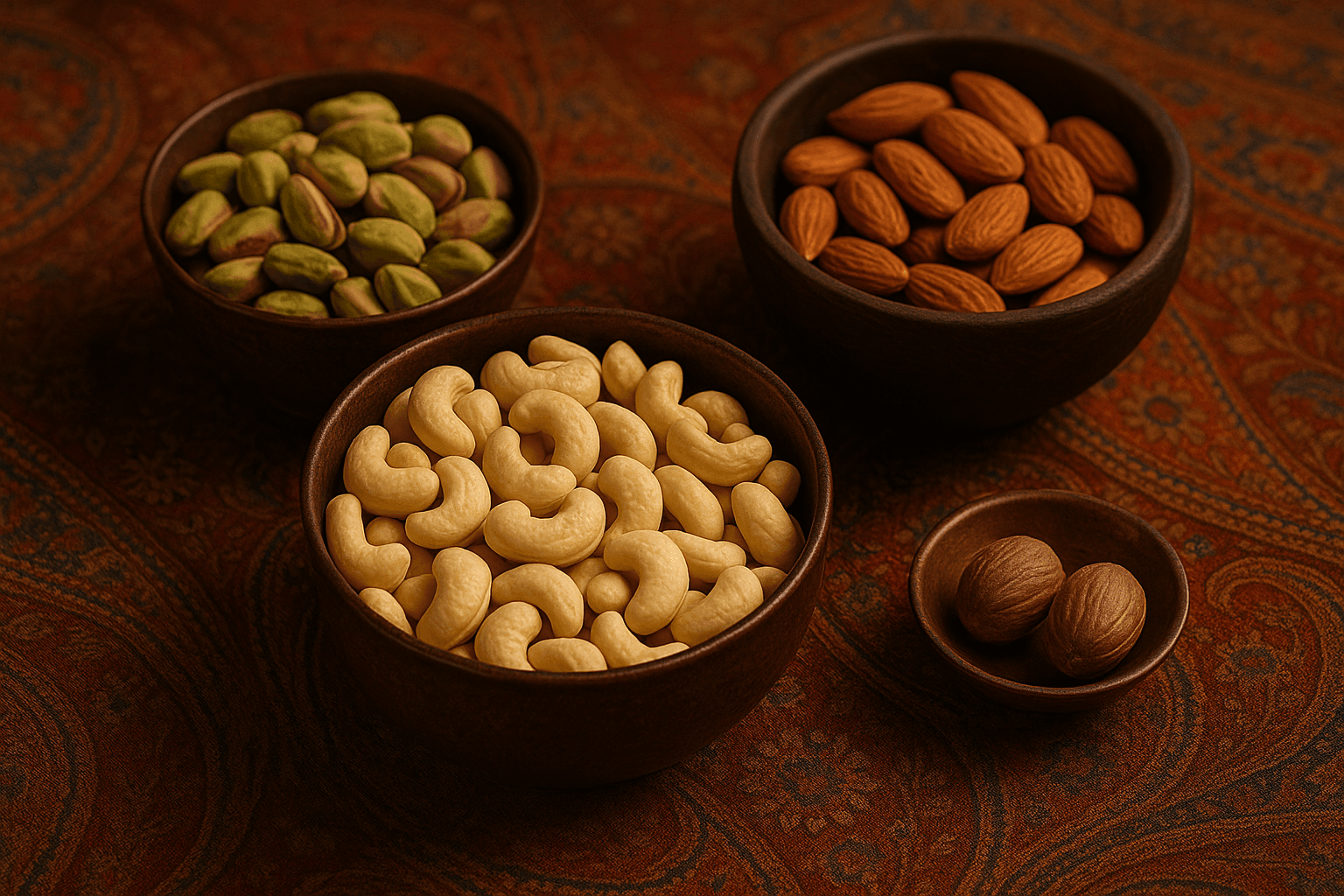
Now that we've cleared up all this confusion about the name, I want to invite you to look at the real thing: the nuts and seeds that are truly part of Indian traditionboth in its cuisine and in Ayurveda.
India is a land of plenty, and its markets overflow with ingredients that have been used for centuries as food, medicine and a symbol of hospitality. Here are some of the true "nuts of India", those that are part of its history, its flavors and its millenary wisdom. -and which, as you'll see, don't need borrowed names to shine. ✨
Cashew nut (Kaju)
Although it originated in Brazil, the cashew found a fertile home in India. In Goa and Kerala it is grown in abundance, and is the star of creamy curries, delicate sweets and mixed nuts and dried fruit (the famous namkeen). The masala kaju are fried cashew nuts seasoned with spices... and they are finger-licking good.
It is a source of magnesium, iron and healthy fats.
Walnut (Akhrot)
The common walnut we are all familiar with is also present in India, especially in the region of Kashmirwhere cold winters make this fruit a key energy source. It is used in traditional desserts and is rich in omega 3, ideal for nourishing the brain and skin.
Almond (Badam)
Present in many dishes from the north, from the badam halwa to kheer. Almonds are a symbol of energy and nutrition, and the Ayurveda especially recommended to strengthen the nervous system. Many families soak 5 almonds in water overnight to consume them in the morning with warm milk.
Pistachio (Pistachio)
Pistachio appears as a decoration in many Indian sweets, ranging from the barfi to the kulfi. It is a symbol of quality and is offered to guests as a sign of hospitality. In Ayurveda it is used to improve circulation and cardiovascular health.
Nutmeg (Jaiphal)
It is not a nut as such, but its use is so potent and symbolic that it deserves to be on this list. In small quantities, nutmeg is a spice that according to Ayurveda calms the nervous system, helps sleep and is part of some medicinal infusions.
When the name confuses: the importance of being informed
India is an inexhaustible source of wisdom, but it has also been, time and again, victim of misunderstood exoticism and misleading names. The case of the "India nut" is just one more example of how, due to ignorance or misunderstandings, products and properties are attributed to this country that do not belong to him. In this case, the name was not born to highlight the benefits of the Indian world, but because of an old confusion with "Las Indias", as the territories discovered by Columbus were called. However, this label has survived the test of time and continues to generate misunderstandings..
Therefore, from here I invite you - as always - to travel with a conscienceto look beyond what a pretty name says, and to choose from knowledge and authenticity. Because when it comes to health, tradition and spirituality, it is essential to be thoroughly informed and to honor the truth..
And because India does not need miracles to be invented: she is already full of them.

Leave a Reply